Reliable piping systems are essential for the safe and efficient movement of water, wastewater, chemicals, and other fluids. Whether used in residential projects, agriculture, industrial facilities, or major infrastructure, the choice of piping material can directly affect durability, maintenance, operating efficiency, and service life. HDPE pipes and fittings have become a practical solution for many modern piping requirements because they combine strength, flexibility, corrosion resistance, and reliable jointing performance.
1. High Durability and Impact Resistance
One of the key advantages of HDPE is its toughness. HDPE pipes can withstand mechanical stresses and impact better than many conventional piping materials. Their flexibility allows them to absorb certain external forces rather than easily cracking or breaking.
This makes HDPE pipes useful in applications where pipes may experience ground movement, handling stresses, traffic loads, or challenging installation conditions. The material’s high flexural and impact strength contributes to overall system reliability.
2. Excellent Corrosion and Chemical Resistance
Unlike metallic pipes, HDPE does not rust. It is also resistant to many chemicals and corrosive soil conditions. This characteristic can be particularly valuable for underground piping systems where exposure to moisture, salts, chemicals, or aggressive soil may affect conventional materials.
Read More: Before You Build Anything, Pay Attention to the Ground
Because HDPE is chemically resistant, it can be suitable for applications involving water, wastewater, irrigation, drainage, and selected industrial fluids, provided the material is properly specified for the service conditions.
3. Leak-Resistant Joints and Fittings
Leaks can reduce system efficiency, damage surrounding structures, and increase maintenance requirements. HDPE piping systems can use reliable joining methods that create secure connections between pipe sections and fittings.
When correctly designed, prepared, and installed, these joints help create a continuous piping network with reduced risk of leakage. This is particularly important for water supply, irrigation, drainage, and other systems where fluid loss needs to be minimized.
4. Flexibility and Easier Installation
HDPE pipes are relatively lightweight and naturally flexible. This can make transportation, handling, and installation easier, particularly when pipelines need to follow gradual changes in direction.
Coil pipes can also reduce the number of joints required in suitable applications. Fewer joints can simplify installation and reduce potential points of failure. However, proper trench preparation, joining procedures, and installation practices remain essential for achieving expected performance.
5. Smooth Internal Surface and Efficient Flow
The internal surface of HDPE pipes is smooth, which can support efficient fluid movement. A smooth bore can reduce resistance to flow and help maintain hydraulic performance.
This characteristic is useful in water supply, irrigation, drainage, and pumping applications. Good hydraulic design still requires appropriate pipe sizing, pressure ratings, flow requirements, and installation conditions, but the material’s smooth internal surface is an important performance advantage.
6. Reduced Maintenance Requirements
Durability, corrosion resistance, flexibility, and dependable joints can contribute to lower maintenance requirements over the operating life of a piping system. HDPE does not require corrosion protection in the same way as many metallic systems, while its resistance to several environmental factors helps reduce common material-related problems.
Lower maintenance needs can also make HDPE an attractive choice where access to buried pipelines is difficult or where interruptions to service need to be minimized.
7. Long-Term Reliability and Cost-Effectiveness
A piping system should be evaluated on more than its initial purchase price. Installation effort, maintenance, repairs, operational efficiency, and expected service life all influence the total cost of ownership.
The combination of lightweight construction, durability, corrosion resistance, flexible installation, and reliable jointing can make HDPE a cost-effective piping solution over the long term. Proper design and installation are essential to realizing these benefits.
Applications of HDPE Pipes and Fittings
The versatility of HDPE pipes and fittings makes them suitable for numerous applications. In agriculture, they can be used for irrigation networks, including micro-irrigation and sprinkler systems. Water supply projects can benefit from their durability and corrosion resistance, while sewerage and drainage systems can take advantage of their flexibility and leak-resistant jointing.
HDPE piping is also used in infrastructure and industrial applications where resistance to environmental conditions, chemicals, or abrasion is important. Depending on the specific product, design requirements, and applicable standards, HDPE systems can serve a wide range of fluid transportation needs.
Why Choose HDPE for Modern Piping Systems?
Modern piping projects increasingly require materials that can balance strength, efficiency, installation practicality, and long-term reliability. HDPE addresses these requirements through a combination of mechanical toughness, flexibility, corrosion and chemical resistance, smooth internal surfaces, and dependable joining options.
Read More: Choosing Trusted Asphalt Contractors Utah for Quality Results
For homeowners, contractors, engineers, and infrastructure professionals, selecting the right HDPE pipes and fittings should involve considering operating pressure, pipe size, application, environmental conditions, relevant standards, joining methods, and installation requirements. A properly specified system can provide dependable performance while helping control maintenance and life-cycle costs.
APL Apollo HDPE Pipes and Fittings
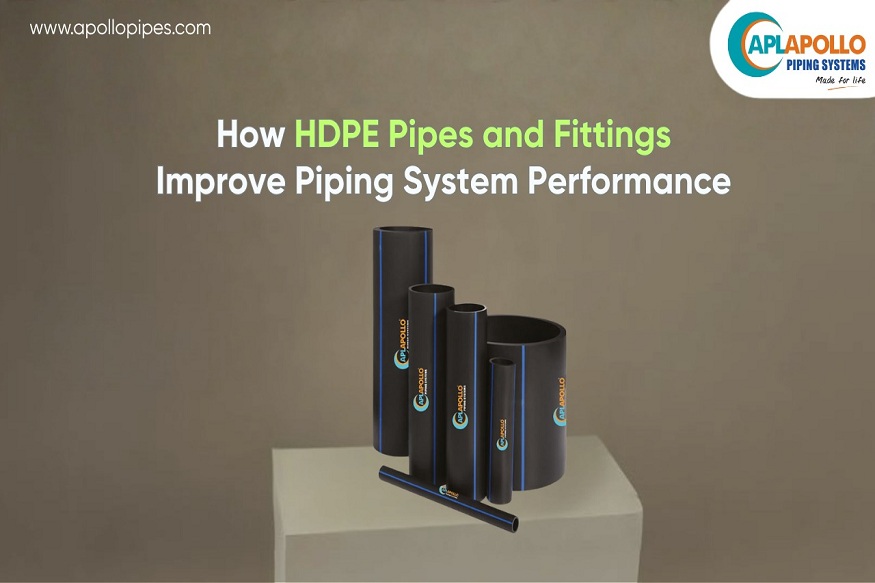
APL Apollo’s HDPE Pipes and Coils are manufactured using polyethylene and are designed with low creep rupture properties. The company states that its HDPE Pipes and Fittings are used for micro and sprinkler irrigation, water supply and irrigation, sewerage and drainage pumping, and other industrial projects. The product range is described as lightweight, strong, long-lasting, flexible, UV stabilized, chemically inert, resistant to acids and alkalis, and suitable for corrosive or marshy soils; it also offers abrasion resistance for applications involving materials such as slurry and ores. APL Apollo lists pipes and fittings in sizes from 20 mm to 315 mm, in PE 63, PE 80, and PE 100, with products specified according to IS 4984 and IS 14333. The company also highlights smooth flow and leakproof jointing as features of its HDPE coil pipe range.